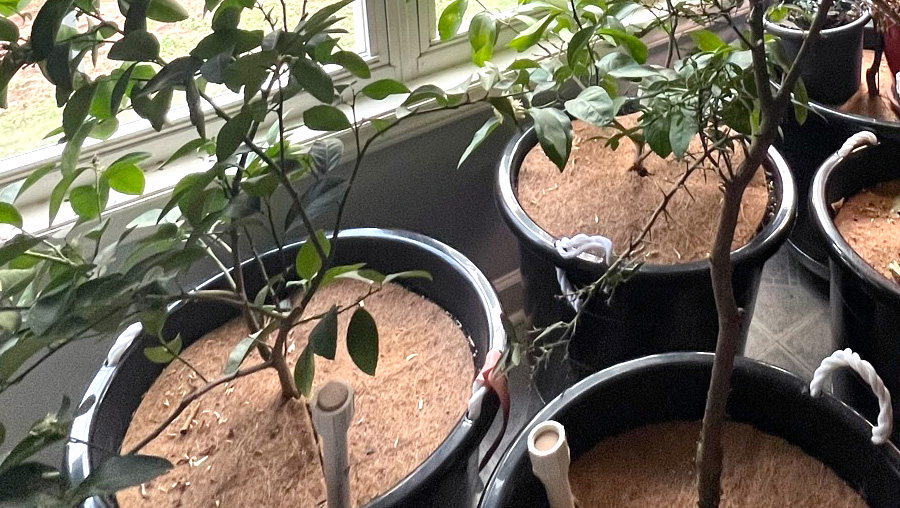
Every year I bring my citrus trees in for the winter and they throw a fit… they dry out, drop leaves, and clearly struggle. I thought I would make some self-watering (wicking) pots so they could have access to more water, without sitting in the water with soggy roots. I chose the supplies for this project based on affordability, and the ability to place the large tubs on rolling dollies for easy transport outside/inside.

And as a bonus, this method would make a great planter for tomatoes, peppers, mixed mini gardens, and other tree types as well.
I filmed this a few months ago but I wanted to make sure it would work before sharing. I’ve made five of these pots so far and my trees are thriving!
Here’s how I made large, inexpensive self-watering pots for around $20 (minus the dolly) to upgrade my summer-loving citrus trees.
ROLLING SELF-WATERING CITRUS POT PROJECT LIST:
SUPPLIES:
- Large, 17-gal Rope Tote Bucket
- Large Party Drink Tub
- 3/4-inch PVC Tube
- 3/4-in x 1 in PVC Reducer Blushing (optional)
- Old T-shirt or Fabric
- Discarded nursery pots, Fit to height desired for reservoir
- 16″ Rolling Plant Dollies (optional)
TOOLS:
- Battery Powered Drill
- 3/4-in Hole Saw Bit
- Drill Bits (9/32″ & 1/4″)
- PVC Pipe Cutter Tool
- Scissors
- Take the plastic party drink tup and flip it upside down to drill into the bottom.
- Using the 3/4″ hole saw and your drill, slowly make a hole toward the edge for the pipe to fit into. Go slow so you do not crack the plastic.
- Take your drill bits and add a bunch of holes across the bottom to create your drainage. Set this aside.
- Take your discarded nursery pot and place it next to the large roped tub to indicate where the tub will stop. Using your 9/32″ drill bit, make a drainage hole just below where the top of the discarded pot will sit so that water can run out if the pot gets too full (we do not want the water to sit and drown our tree roots). I made one on each side of the tub.
- Place the discarded nursery pot in the bottom of the roped tub to create support, and add the party drunk tub on top, with the holes facing the bottom.
- Take the PVC pipe fitting and cut a notch off the bottom using the pipe cutter tool. This is so that the bottom of the pipe does not sit flat against the bottom, blocking water flow. You can also add the reducer blushing (if using) as well. Place the finished pipe fixture in the hole you created in the drink bucket, notched side facing down in the bottom.
- Take your t-shirt (or other wicking fabric) and cut some thick strips to add to the container so that they can hang down into the water from the soil reservoir–this will allow the soil/plant to pull up the water it needs. I also cut off a piece of the t-shirt sleeve to make a little seal around the tube at the bottom so large amounts of soil drop through.
- Now you can fill the top with your chosen soil mixture. I used one bag of organic compost/manure (1-Cu Foot), one coco coir brick, and half a bag of organic perlite for drainage, but you could also add some sand to the mix.
- Add water to the bottom of the pot using the PVC pipe tube and check periodically to see if it needs more water.
NOTE: You should clean out the water periodically to make sure it doesn’t become stagnant and filled with stinky bacteria. Harmful bacteria can thrive in water with low oxygen content. If this does happen and you cannot easily get the water out to refresh ASAP (like during the winter when it is cold outside), add a little hydrogen peroxide to the water reservoir. Used in hydroponics, hydrogen peroxide boosts oxygen and helps combat low oxygen found in warm, room temperature water.
Using 3% hydrogen peroxide, mix 1 Tbsp. (15ml) peroxide per 1 liter water (there is roughly 4 liters in a gallon, so use about 4 Tbsp. per gallon of water–which is about the amount these pots can hold). Add directly to the water to help prevent algae, root rot, and bacteria buildup (SOURCE).
Hydrogen peroxide can be used to treat plants for algae, fungus, and bacteria, but it must be properly diluted and used with caution. Overdosing or prolonged exposure can damage or kill the plants and any beneficial bacteria in the water.
PRODUCTS FEATURED FROM THIS VIDEO:


